A consultant leading a client acquisition strategy session

For coaches, experts, freelancers & small teams

The 90-day client acquisition playbook.

You do not need 90 new ways to get clients. You need a few good steps that work together—and enough time to see what works.

Clear steps you can use Made for service businesses
Start the playbook

Stop posting just to stay busy. Build a clear path to your next client.

Help the right people find you. Give them one easy next step. Show how you help. Stay in touch. Make it simple to hire you.

You do not need to post all day. You do not need seven sales paths. You need one path you can track and improve.

Two-minute check

Your marketing has five jobs.

Check each step that works well today. Your first empty box is often the best place to start.

0/5 coveredStart by helping more of the right people find you in one place.

How it works

Seven simple steps to a new client.

Each step has one job. When a step is missing or weak, people stop there and never reach the end. Here is why each step matters.

01
They find youNo one can hire you if they never hear from you. Pick one or two places to show up every week, so new people keep coming.
02
They take a small stepMost people will not book a call the first time they meet you. A free guide, checklist, or quiz lets them raise a hand with no risk.
03
You stay in touchPeople get busy and forget. A few helpful emails keep you in their mind until they are ready to get help.
04
They see proofPeople believe real results more than big promises. Sharing what worked for others answers the question, “Will this work for me?”
05
They see your serviceAt some point people need to know what you do, who it is for, and what it costs. Clear words here turn interest into a booking.
06
You remind themMany people meant to come back but forgot. A simple reminder ad brings them back while you are still fresh in their mind.
07
They hire youThis is the goal. Make it easy: one button, one clear way to book a call, and no long forms to fill out.

Your next 90 days

Build. Learn. Sell.

Each month has one main job. Follow the steps long enough to learn what truly brings in clients.

By day 30: your engine is built. A stranger can find your page, get your free tool, get six emails, and book a call — and you can count every step.

Week 1 · About 3 hours

Write your one-line message

Builds on: This is the base. Your page, free tool, emails, and posts all repeat this line.

Why it matters: If people can't tell what you do in five seconds, they leave. Every later part of your engine uses this line.

  1. Finish this line: “I help ___ get ___ without ___.”
  2. Example: “I help busy dentists get 10 new patients a month without running their own ads.”
  3. Put the line at the top of your website and social profiles.
  4. Ask a friend to look for 5 seconds and say back who you help.
You are done when your friend can repeat who you help and what result you give.
Week 2 · About 4 hours

Make one free tool and its page

Builds on: Uses your Week 1 line as the page headline. This tool is where every post will send people.

Why it matters: Most people are not ready to buy yet. A free tool lets them start with you today and gives you their email.

  1. Write down the question clients ask you most.
  2. Answer it in a one-page checklist, short guide, or quiz.
  3. Make a sign-up page: your Week 1 line on top, one short promise, and a box for name and email.
  4. Sign up yourself to make sure the tool arrives.
You are done when a stranger can sign up and get the tool in under one minute.
Week 3 · About 4 hours

Write six follow-up emails

Builds on: Starts the moment someone gets your Week 2 tool. Walks them from “just curious” to “ready to talk.”

Why it matters: Most people hire after hearing from you several times. These emails do that work while you do client work.

  1. Email 1: send the tool and say what to do first.
  2. Email 2: share one quick tip they can use today.
  3. Email 3: tell a short client story with a real result.
  4. Email 4: answer the biggest worry, like price or time.
  5. Email 5: explain how you work, step by step.
  6. Email 6: invite them to book a call.
You are done when all six send by themselves, two days apart.
Week 4 · About 1 hour, then 30 minutes a week

Set up your number sheet

Builds on: Counts each part you built in Weeks 1–3, so next month you know which part needs work.

Why it matters: Numbers show you exactly where people stop. Without them you are guessing.

  1. Make a sheet with five columns: visits, sign-ups, calls booked, new clients, money.
  2. Every Friday, fill in last week's numbers.
  3. Circle the step where the number drops the most.

You are done when your engine is running and your first week of numbers is filled in.
Independent consultant reviewing her client acquisition numbers

Your weekly post plan

Stop asking, “What should I post today?”

Every week, post three kinds of content. Each kind has one job. Together they turn strangers into clients.

Attention · 2 a weekGet noticed

Stop the scroll and reach new people.

Example: “3 mistakes that keep dentists' chairs empty.”
Demand · 2 a weekWant help

Show the problem is real and you can fix it.

Example: “How one clinic got 12 new patients in 30 days.”
Decision · 1 a weekDecide

Make it easy to say yes.

Example: “Here's exactly how working with me goes, and how to start.”
MONGet noticed: a common mistake
TUEWant help: teach one step
WEDGet noticed: a surprising fact or story
THUWant help: share a client result
FRIDecide: how you work and how to start

End every post with the same link: your free tool. Send one helpful email and one email about your service each week.

Maya, an independent brand consultant
Maya R.Independent brand consultant

Example story · 90 days

From random requests to a steady list of people who wanted help.

“I thought I needed more posts. I really needed one clear next step and a way to stay in touch.”
4.7×more good-fit contacts
31%of contacts booked a call
6new client projects
Before

Her work looked good, but each page asked people to do something different. She rarely spoke to visitors again after they left.

What changed

She made one free brand check, wrote six helpful emails, shared one client result each week, and ran simple reminder ads.

After

Over 90 days, 174 good-fit people signed up. Fifty-four booked a review. Six became new clients.

This is a made-up example based on common results. Your results will depend on your service, audience, and work.

Use facts, not guesses

Find the step where people leave.

Every step loses some people. That is normal. Your job is to find the step that loses the most—and fix that one first. Check your numbers in the tool below, then read the matching card.

01

Visits, but no sign-ups?

How to spot it

1,000 people visit your site. Only 20 give their email. That means 980 left, and you may never see them again.

Why people leave

The page does not say clearly who it helps or what to click. Or the free tool is not useful enough to trade an email for.

What to do

  • Say who you help and what changes for them at the very top of the page.
  • Make the free tool solve one small problem in ten minutes.
  • Keep one clear button on the page, and repeat it.

Fixed when 3 or more in every 100 visitors sign up.

02

Sign-ups, but no calls?

How to spot it

100 people signed up for your free tool. Only 5 booked a call. The other 95 liked what they saw, then drifted away.

Why people leave

They are not sure it will work for them yet, or you only ask for the call once, at the very end.

What to do

  • Send emails that teach first, then show a real result from someone like them.
  • Tell people exactly what a call is like, so it feels safe to book.
  • Ask for the call in every email, not just the last one.

Fixed when 10 or more in every 100 sign-ups book a call.

03

Calls, but no clients?

How to spot it

10 people booked a call. Only 1 hired you. The calls happened, but the yes never came.

Why people leave

The wrong people are booking, the price or service is unclear, or they worry it will not work.

What to do

  • Check who books before the call, so you talk to people who truly need you.
  • Share a price range early, so no one is surprised.
  • After each call, send an email that repeats the plan, the price, and the next step.

Fixed when 2 or more in every 10 calls become clients.

Fix one step at a time. Fix the worst one first, watch your numbers for two weeks, then move to the next.

Your number check

Your numbers show what to fix next.

Enter numbers from one week or one month. Use the same time period for every box. Look for the step where the most people leave.

A small team planning how to get more clients
Visitors who signed up8.0%
Calls that became clients27.8%
Money per new client$3,000

Try this next: These steps look strong. Help more of the right people find the page, then grow slowly.

The seven rules

Rules that keep the plan on track.

These rules stop the most common mistakes. Follow them and you cannot drift too far off.

01
Sell one main serviceIt is easier to be known for one thing. When you sell three things, people get confused—and confused people do not buy.
02
Share one main free toolOne good tool gets better every time you share it. Five okay tools split your work and teach you less.
03
Ask for one next stepEvery page, post, and email should ask for the same next step. If you ask for two things, most people pick neither.
04
Stay in touchMost people are not ready to hire you the day they find you. A short, helpful email keeps you first in line when they are ready.
05
Track where clients came fromAsk every new client, “Where did you hear about me?” Then spend more time on the places that bring real clients.
06
Give the plan time to workMost people need to see you five or more times before they trust you. Stopping early throws away everything you built.
07
Fix the weakest stepA weak step loses people at that point. Fix the worst step first, one at a time, so you can tell what worked.
Not sure where to start?Get a free mini audit

The pieces you build

Four parts you can see and use.

The plan is made of four simple pieces. Click each one to see what it looks like, what it does for you, and what you need to make one.

A landing page with one clear headline, one email field, and one lime green button

One page that asks for one thing

A new visitor should know who you help, what gets better for them, and what to click — in about five seconds. That means one promise at the top, one free tool, and one button you repeat.

Going well when 3 or more in every 100 visitors sign up.

What you need
  • A headline that names the result
  • One free tool worth an email address
  • One button, shown at the top and again at the bottom

From business owners like you

What changed for them.

People who followed the same steps, in their own words. Same plan, different businesses.

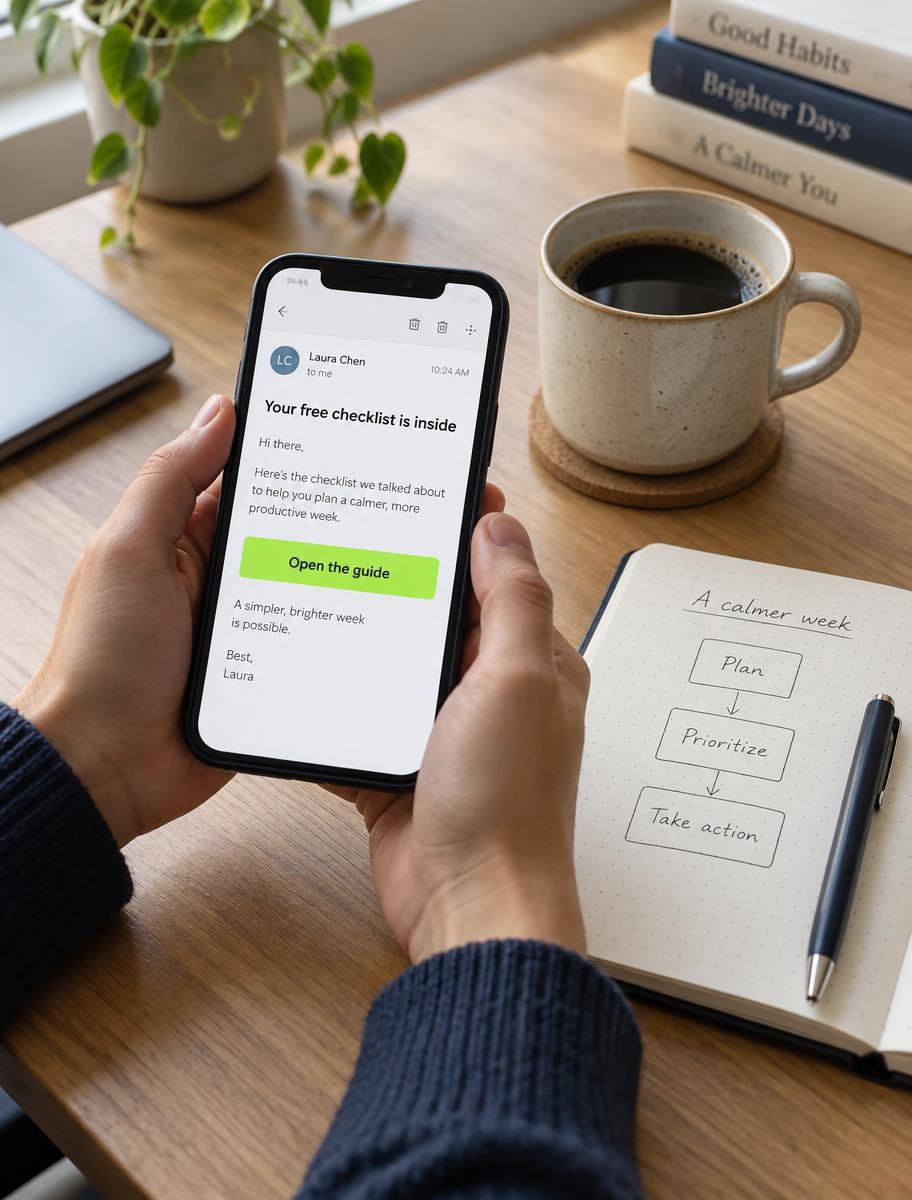
A business owner reading a follow-up email on her phone at a desk
“
I used to end every week busy and unsure. Now I open the same screen, see where people are leaving, and fix one thing. My phone rings more because I am finally talking with the right people.
JBJordan B.Fitness coach for busy parents · Austin, TX5 clients in 60 days

I stopped trying to post every day. I wrote one checklist, six emails, and asked for the call in every one. Three clients came in eight weeks.

DMDana M.Career coach · Columbus, OH
3 clients in 8 weeks

My page said everything, so it said nothing. We cut it down to one promise and one button. Sign-ups tripled in a month.

MTMarcus T.Wedding photographer · Atlanta, GA
3× more sign-ups in 30 days

I was afraid to say a price out loud. Once the range was on the page, the wrong people stopped booking and the right ones started.

PSPriya S.Bookkeeper for trade businesses · Phoenix, AZ
4 hires from 6 calls

These quotes are examples while we gather the real ones. Each one gets replaced with a result from an actual Client Engine client.

Want me to find the weak step?

Get a fresh look at how your business finds new clients.

I’ll look at what you already have. Then I’ll record a short video. It will show where people may be leaving, what to fix first, and what you can leave alone.

  • No long, hard-to-read report
  • No high-pressure sales call
  • Only the first few steps that matter